
Care Information and Tips/Tricks
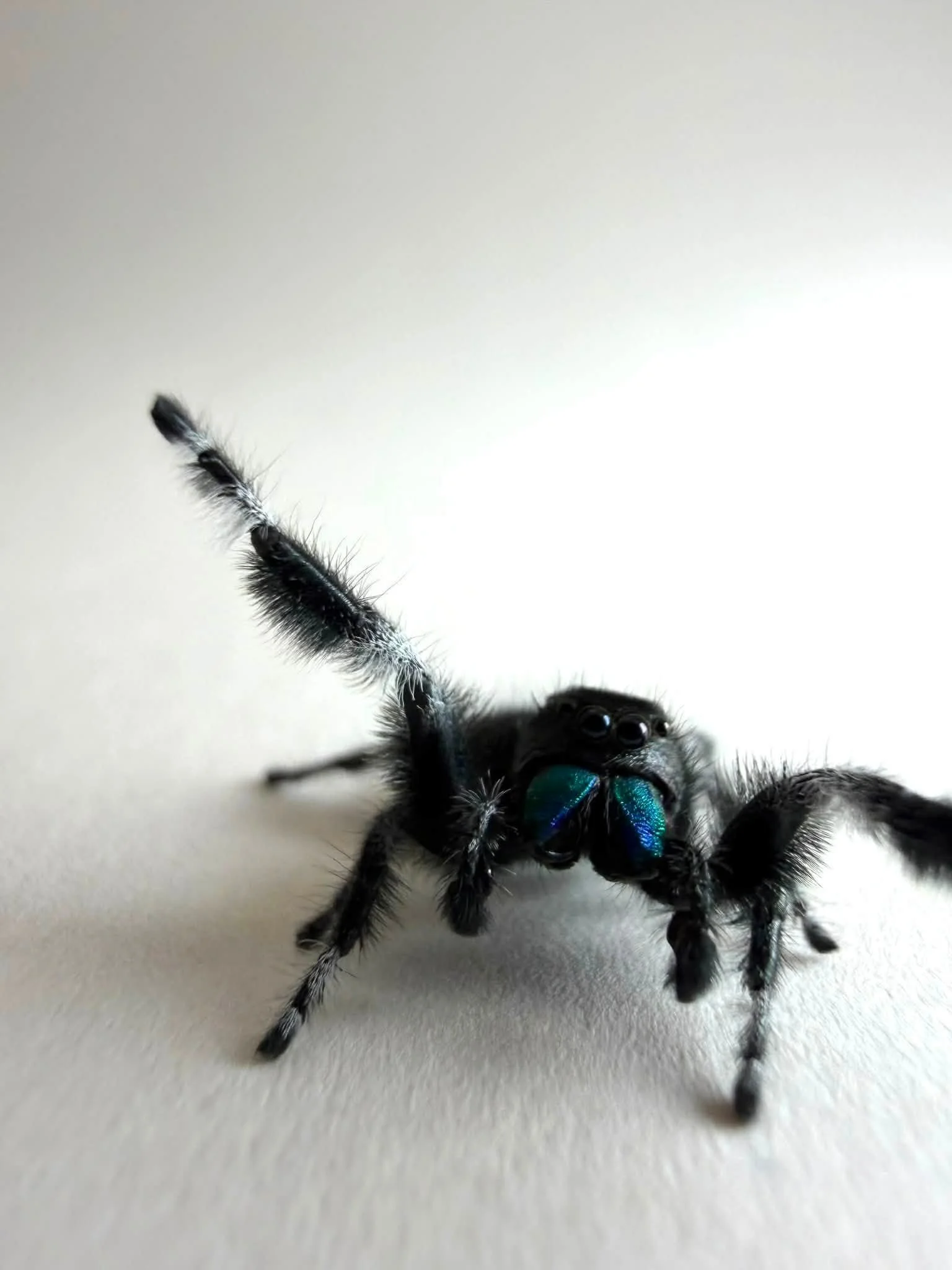
Regal Jumping Spider Care Guide
Thank you for choosing Steele’s Regal Jumpers!
We are so excited that one of our captive-born Regal Jumping Spiders is joining your family. Every spider we raise is cared for with patience, attention, and lots of love, and we want to make sure you feel confident caring for your new little friend.
Regal Jumping Spiders (Phidippus regius) are intelligent, curious, active, and absolutely fascinating little animals. They are generally very easy to care for once you understand their basic needs.
This guide will walk you through everything you need to know—from the moment your spider arrives to their everyday care.
WHEN YOUR SPIDER ARRIVES
Shipping can be stressful for a little spider, so please give them time to settle in.
The first thing to do:
Carefully open the package.
Locate your spider's travel container.
Gently place the container somewhere quiet and away from direct sunlight.
Check that your spider is alive and appears responsive
DOA POLICY: In the rare occasion your jumper doesn’t make it, another will be sent for the cost of shipping. Please email proof (photo/video) within 1 hour of delivery, along with your order #, to steelesregaljumpers@gmail.com
Allow your spider to rest.
PLEASE DO NOT IMMEDIATELY HANDLE YOUR SPIDER.
Your spider has just experienced transportation, changes in temperature, vibrations, and unfamiliar surroundings.
Give them at least several hours to settle in before attempting to interact with them.
If your spider is hiding, sitting still, or appears nervous when they arrive, don't panic!
Jumping spiders can spend quite a bit of time hiding after shipping. This does not necessarily mean something is wrong.
If your spider arrives during the evening:
Let them rest overnight.
There is no need to wake them up to feed or handle them.
YOUR SPIDER'S NEW HOME
Regal Jumping Spiders don't need a huge enclosure, but they do need an enclosure that allows them to climb, explore, hunt, and build their little hammock retreats.
Enclosure basics:
Your enclosure should have:
Plenty of ventilation
Secure openings
Climbing surfaces
Artificial or live plants
Twigs, cork, or other safe décor
Places to hide
A secure top or upper area where your spider can build a hammock
Ideal enclosures size for adults is 4” × 4” × 8”
Vertical space is important!
Jumping spiders naturally spend much of their time higher up in their environment, so a taller enclosure is generally preferable to a wide, flat enclosure.
A secure, well-ventilated enclosure designed specifically for arboreal jumping spiders is ideal.
Avoid:
Enclosures with large gaps your spider can escape through
Sharp or rough decorations
Standing water
Poor ventilation
Direct sunlight
Overcrowding the enclosure with décor
Your spider should always have enough open space to move around and hunt.
TEMPERATURE
Regal Jumping Spiders generally do well at comfortable household temperatures.
A typical target is approximately:
70–80°F (21–27°C)
Avoid placing the enclosure:
Directly next to a heater
Directly next to an air conditioner
In direct sunlight
Near a drafty window
Anywhere temperatures fluctuate dramatically
NEVER leave the enclosure in direct sunlight.
A small enclosure can heat up extremely quickly in the sun, which can become dangerous or fatal.
HUMIDITY & HYDRATION
Your spider needs access to water, but they do not need a water bowl.
Jumping spiders are tiny and can potentially become trapped or drown in standing water.
Instead, provide hydration by lightly misting one side of the enclosure.
Small droplets on the enclosure walls allow your spider to drink.
A good routine:
Lightly mist the enclosure once a day or as needed, allowing it to dry between mistings.
The goal is not to keep the enclosure constantly wet.
Good ventilation is extremely important.
Watch your enclosure.
If everything stays wet for long periods of time, increase ventilation or reduce the amount of misting.
If the enclosure becomes completely dry and your spider isn't getting hydration, lightly mist again.
LIGHTING & DAY/NIGHT CYCLE
Regal Jumping Spiders benefit from a normal day/night cycle.
A simple household lighting schedule works well.
Day:
Light for approximately 10–12 hours
Night:
Allow approximately 12–14 hours of darkness
Your spider needs darkness to rest.
You do not need to keep a light shining on the enclosure at night.
Natural room lighting can work, but avoid placing the enclosure in direct sunlight.
FEEDING YOUR REGAL JUMPER
One of the best parts of owning a jumping spider is watching them hunt!
Regal Jumping Spiders are active predators prefer live prey.
Appropriate prey depends on the size and age of your spider.
Common feeder options include:
Flightless fruit flies
Appropriately sized crickets
Mealworms
PREY SIZE MATTERS!
A good rule is to offer prey that is no larger than your spider's body size, with smaller prey being appropriate for young spiders.
When in doubt, go smaller rather than larger.
HOW OFTEN SHOULD I FEED?
There isn't one perfect feeding schedule for every spider.
Age, size, temperature, activity level, and individual appetite all make a difference.
As a general guideline:
Younger spiders:
Offer appropriately sized prey every 1–2 days.
Juveniles/subadults:
Offer food approximately every 2–3 days, adjusting based on appetite.
Adults:
Offer food approximately 2–3 times per week, adjusting according to the individual spider.
Your spider may occasionally refuse food.
That is okay!
Never force-feed a jumping spider.
VERY IMPORTANT: WHAT IF MY SPIDER REFUSES FOOD?
A spider refusing food does not automatically mean something is wrong.
There are several reasons a jumping spider may refuse a meal.
They may be:
Resting
Preparing to molt
Simply not hungry
Stressed from moving
Affected by temperature
Uninterested in the particular prey
If your spider refuses food:
Remove uneaten prey and try again later.
MOLTING
Molting is one of the most important things to understand as a jumping-spider owner.
As your spider grows, it must shed its old exoskeleton.
Before a molt, you may notice your spider:
Spending more time in its hammock
Becoming less active
Refusing food
Looking darker or different
Staying hidden
Building a thicker hammock
Becoming less responsive
DO NOT DISTURB A MOLTING SPIDER.
This is extremely important.
If you believe your spider is preparing to molt:
Do not handle them.
Do not poke their hammock.
Do not attempt to remove them.
Do not feed them.
Allow them to complete the process undisturbed.
A molt can take hours or, depending on the individual and life stage, longer.
THE HAMMOCK
You will probably notice your jumping spider building little silk hammocks throughout the enclosure.
These are completely normal!
Your spider may use its hammock for:
Sleeping
Resting
Molting
Spending time when it doesn't want to be disturbed
You may find your spider tucked tightly into a tiny silk hammock at night.
That is normal!
One of the cutest things you'll see:
A sleeping jumping spider often tucks its legs underneath its body and becomes much less active.
HANDLING YOUR REGAL JUMPER
One of the wonderful things about Regal Jumping Spiders is that many become comfortable around people.
However, every spider has its own personality.
Some are confident little explorers while others are shy.
The key is patience.
Never grab your spider, squeeze them, pull them out of their hammock, or force them onto your hand.
HOW TO HANDLE SAFELY
When your spider is awake and active:
Place your hand or finger near them.
Move slowly.
Allow your spider to investigate you.
Let them climb onto you voluntarily.
Keep your hand low over a safe surface.
Avoid sudden movements.
Jumping spiders can jump surprisingly far!
Always handle over a safe surface.
A bed, couch, table, or other soft area is preferable to a hard floor.
WILL MY REGAL JUMPING SPIDER BITE ME?
Jumping spiders are not naturally aggressive toward people.
They are tiny predators that are much more interested in hunting their food than bothering humans.
Most will choose to run or jump away when frightened rather than confront a person.
However, they are still wild-type predators with defensive behaviors, and any spider can bite if it feels threatened or is mishandled.
The best way to prevent a defensive bite is simple:
Respect your spider's boundaries.
If they don't want to be handled, let them be.
CLEANING THE ENCLOSURE
Jumping spiders are relatively clean pets.
You don't need to completely dismantle the enclosure every week.
Use plain or distilled water to wipe down enclosures.
For tougher spots or disinfecting during a deep cleaning, you can use a mixture of 1-part white vinegar to 5-parts water, provided the enclosure is wiped thoroughly after.
Never use harsh chemicals and avoid using soaps, detergents, and acetone.
Regular maintenance:
Remove dead feeder insects
Remove uneaten prey
Remove visible waste when possible
Wipe dirty areas carefully
Replace décor if it becomes contaminated or moldy
BE CAREFUL AROUND HAMMOCKS.
Do not destroy or remove your spider's hammock unless absolutely necessary.
They put a lot of effort into their little silk homes!
WHAT ABOUT MOLD?
Good ventilation is your best defense against mold.
If you notice mold developing:
Remove the affected material if it can be safely removed.
Improve ventilation.
Reduce excessive moisture.
Make sure the enclosure has an opportunity to dry between mistings.
Avoid keeping the enclosure constantly damp.
MOST IMPORTANTLY...
Your jumping spider doesn't need perfection.
They need:
Safety
A suitable environment
Hydration
Appropriate food
A day/night cycle
Peace during molting
Patience
The more time you spend observing and interacting with your spider, the more they will be confident and willing to interact more with you.
Every spider is different, and that's part of what makes keeping jumping spiders so much fun!
THANK YOU FOR CHOOSING STEELE’S REGAL JUMPERS
We are incredibly grateful that you chose to bring one of our babies into your home.
Our goal isn't just to find homes for our spiders—we want to help create happy, healthy, long-lasting relationships between people and these amazing little creatures.
If you ever have questions about your spider, its behavior, feeding, molting, enclosure, or anything else, please don't hesitate to reach out to us.
We are always happy to help!
From our spider family to yours:
Thank you for loving one of our little jumpers.
— Steele’s Regal Jumpers
Captive born and raised with care and love. Sent to their forever homes with hope for many happy molts and adventures.